

Guide 05 · Pillar
Supermarket Refrigeration: Complete Selection Guide
Plan supermarket refrigeration by zone and store size. Compare island freezers, multidecks and cold rooms with sizing formulas, spec checklists and reference scenarios.
On this page (11)
- Quick Answer
- 1. Map the Store by Temperature Zone
- 2. Equipment Selection by Zone
- 3. Sizing by Store Format
- 4. The Specification Sheet That Prevents Costly Mistakes
- 5. Reference Scenarios
- 6. Energy, Refrigerant and Total Cost of Ownership
- 7. Procurement and Rollout Planning
- 8. Common Mistakes in Supermarket Refrigeration
- FAQ
- References & standards cited
Quick Answer
Select supermarket refrigeration by zone and store size: use 0.08–0.12 linear metres of refrigerated display per m² of sales floor, split across chilled multidecks, island freezers and upright glass-door cases, with back-room cold rooms at 20–30% of display capacity. Specify temperature class under ISO 23953-2, match climate class to store ambient, and choose refrigerants that clear local phase-down rules. The right mix balances merchandise visibility, energy cost and restocking efficiency over a 10-year cabinet life.
1. Map the Store by Temperature Zone
A supermarket is not one refrigeration problem — it is four:
| Zone | Temperature | Products | Typical equipment |
|---|---|---|---|
| Chilled display | +2 to +8 °C | Dairy, deli, fresh meat, prepared food | Open multideck, glass-door chillers |
| Frozen display | −18 °C or colder | Frozen meals, vegetables, ice cream | Island freezers, upright glass-door freezers |
| Fresh produce | +8 to +12 °C, high humidity | Fruit, vegetables, flowers | Humidified open multideck |
| Back-of-house | +2 to +8 °C / −18 °C | Stock rotation, bulk storage | Cold rooms, walk-in freezers |
Design each zone separately. A single specification applied across all zones will over-cool produce, under-freeze ice cream, and waste energy.

2. Equipment Selection by Zone
Chilled multidecks (open or glass-door)
Open multidecks maximise product visibility and impulse sales but consume significantly more energy than glass-door cabinets. Glass-door units cut energy use and hold temperature more steadily, but slow browsing.
Decision rule: In air-conditioned stores where energy cost is high, glass-door cabinets win on total cost. In high-footfall fresh zones where visibility drives sales, open multidecks justify their energy use.
Specify:
- Temperature class M1 / M2 (+2 to +8 °C) or equivalent under ISO 23953-2.
- Climate class matched to ambient — class 3 (25 °C / 60% RH) is common; hotter markets need class 4 (30 °C) or tropicalised units.
- LED lighting with low heat output.
- Defrost type: off-cycle for chilled, electric or hot-gas for frozen.
Island freezers
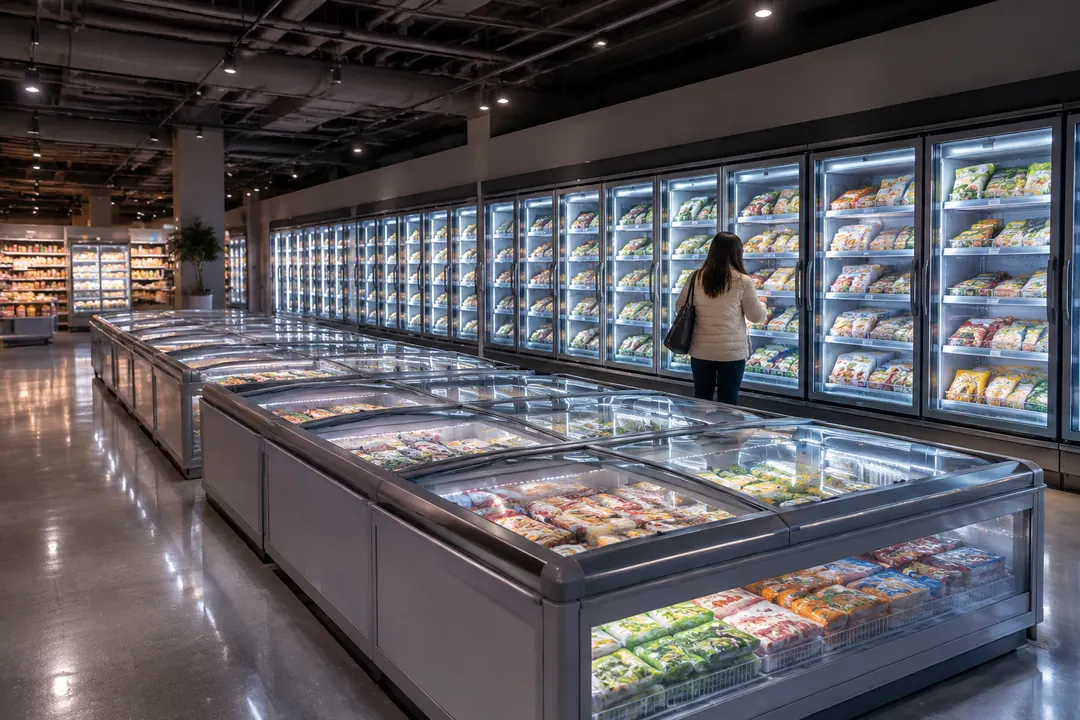
Chest-style, open-top or sliding-lid cases viewed from above. A typical unit is about 2.5 m long and self-contained.
Use for: high-volume frozen lines, ice cream, bulk frozen vegetables. Trade-off: lower energy than upright glass doors, but a larger floor footprint per SKU and less eye-level visibility.
Upright glass-door freezers
Vertical reach-in cases, typically 0.75–1.35 m wide.
Use for: frozen food at eye level, premium impulse lines, stores where floor space is expensive. Trade-off: more floor-efficient per SKU than islands, but needs door-swing clearance and higher energy per unit of display.
Cold rooms and walk-in freezers
Back-of-house storage for stock rotation. Size at 20–30% of display capacity, based on delivery frequency. A store receiving deliveries three times a week needs less back-room space than one receiving weekly deliveries.
3. Sizing by Store Format
| Store format | Sales area | Display length | Typical equipment mix |
|---|---|---|---|
| Convenience store | 80–150 m² | 8–18 m | Glass-door chillers, small multideck, 1–2 upright freezers, under-counter cold room |
| Standard supermarket | 300–600 m² | 25–60 m | Dairy/deli multideck run, 4–8 island freezers, upright freezer bank, cold room + freezer room |
| Large supermarket | 800–1,500 m² | 65–150 m | Extended multideck runs, 10–20 islands, dedicated ice-cream chests, multiple cold rooms, preparation refrigeration |
| Hypermarket | 2,000 m²+ | 160 m+ | Zoned refrigeration master plan, mixed plug-in and remote systems, central plant, large cold stores |
Calculation method: display length (m) = sales area (m²) × 0.08–0.12. Use the higher end for small stores and fresh-heavy assortments, the lower end for large stores with high shelf density outside refrigeration.
4. The Specification Sheet That Prevents Costly Mistakes
A workable RFQ line item needs more than "upright freezer, 2 units." Specify:
- Internal and external dimensions, footprint tolerance and packed dimensions
- Temperature and climate class under ISO 23953-2
- Refrigerant type and charge weight per circuit
- Compressor brand and displacement, self-contained vs remote condensing
- Insulation thickness and density — typically 50–60 mm cyclopentane-blown PU foam at 38–42 kg/m³, conductivity around 0.020–0.022 W/(m·K)
- Door swing direction (left/right hinge) and glass type (anti-fog, heated, low-e)
- Supply voltage and frequency — 220 V/50 Hz vs 110 V/60 Hz
- Defrost method and drainage provision
- Certification for the destination market (CE, UL/ETL, local)
Thinner or lower-density foam still holds temperature class on paper, but raises compressor runtime and defrost frequency — visible on the energy bill within the first season.
Charge limits and destination-market rules are in R290 vs R600a vs R490, finishes and liners in Commercial Refrigerator Materials, and clearances in How to Size a Commercial Refrigerator for Your Store.
5. Reference Scenarios
These three scenarios are illustrative composites built from typical industry parameters. They are not records of completed SEEBERR projects, and no performance figures in them should be quoted as measured results. Use them to sanity-check your own specification; verified project references and measured data are available from SEEBERR on request.
Scenario 1 — 450 m² Supermarket, Southeast Asia (ambient 30 °C)
Challenge: An existing store used open multidecks with R404A cabinets, facing high energy bills and failing temperature stability during afternoon peaks.
Solution:
- 36 linear metres of display: 14 m chilled multideck (climate class 4), 8 upright glass-door freezers, 6 island freezers, plus an 8 m dairy/deli run.
- Refrigerant switched to R290 plug-in cabinets with charge under 500 g per circuit, built to IEC 60335-2-89:2019.
- Back-room cold room and freezer room at 25% of display capacity.
- Tropicalised compressors rated for 43 °C ambient.
Outcome: Product temperature held within class across the day; compressor runtime reduced; refrigerant cost removed the HFC quota exposure. Energy savings came from the combination of glass doors, better insulation and R290 — not from refrigerant alone.
Scenario 2 — 1,100 m² Large Supermarket, Europe (F-gas regulated)
Challenge: Replace end-of-life R404A rack system under EU Regulation 2024/573 while keeping the store trading.
Solution:
- Phased replacement zone by zone: chilled multidecks to low-GWP plug-in R290 units, frozen aisle to CO₂ (R744) cases where charge rules made A3 cabinets impractical.
- Display length 88 m, with 12 island freezers and a 20 m multideck run.
- Temperature logging added to all chilled and frozen cases for HACCP documentation.
Outcome: Full compliance with the 2025 self-contained GWP threshold, simplified servicing with two refrigerant types, and improved audit readiness.
Scenario 3 — 120 m² Convenience Store, North America (110 V/60 Hz)
Challenge: New fit-out needing US-certified equipment with correct charge limits and voltage.
Solution:
- 12 linear metres: glass-door beverage coolers, one dairy multideck, two upright freezers and an under-counter cold room.
- R290 cabinets to UL 60335-2-89 Ed. 2 with charge under the 300 g US ceiling — a separate SKU from the 500 g IEC version.
- All units on dedicated circuits with the correct 110 V/60 Hz supply.
Outcome: Smooth certification and import clearance; a single refrigerant type across the fleet simplified technician training.
6. Energy, Refrigerant and Total Cost of Ownership
Purchase price is a small part of a supermarket's refrigeration cost over 10 years. Model these factors:
| Cost driver | Impact | How to control it |
|---|---|---|
| Compressor energy | Largest ongoing cost | Glass doors where viable, correct insulation, efficient compressors, avoid hot locations |
| Defrost energy | Significant in frozen cases | Optimise defrost frequency; hot-gas where available |
| Refrigerant service | Rising for high-GWP HFCs | Specify low-GWP from the start |
| Downtime | High cost in fresh departments | Redundancy, service access, spare-parts availability |
| Maintenance | Coil fouling, door seals | Scheduled cleaning and seal replacement |
A useful check: ask suppliers for kWh/day figures at the same climate class. A cabinet quoting lower energy at climate class 3 cannot be compared fairly with one measured at class 4.
7. Procurement and Rollout Planning
For chain buyers and shopfitters, four numbers shape the plan:
- MOQ and lead time. Direct factory orders often run 10–20 units per model with 25–35 day production for standard colours; distributor orders may require 40–60 units. Custom branding typically adds 7–10 days.
- Container loading. A 40HQ container typically carries 20–26 mixed island and upright units depending on model mix. Build rollout plans backward from this figure.
- Certification documents. Request CE/UL declarations, compressor certificates and refrigerant declarations with every quote.
- Service network. Confirm technician training and spare parts in the destination country before finalising the specification.
For multi-store rollouts, standardise on a small set of SKUs. Fleet commonality reduces spare-parts inventory and training cost far more than per-unit price negotiation.
8. Common Mistakes in Supermarket Refrigeration
- Buying by unit price instead of lifecycle cost. A cheaper open case can cost thousands more in energy over a decade.
- Mixing refrigerants without a service plan. Two gases mean two tool sets, two trainings and two stock lines.
- Ignoring climate class in hot markets. Tropical markets need higher climate class ratings.
- No back-room capacity. Display-only plans fail when delivery schedules slip.
- Overlooking defrost water. Every defrost cycle needs drainage; plan it in the drawing stage.
- Substituting chilled cases for frozen lines. A chilled-rated cabinet in a frozen-food position will fail product temperature and food-safety checks.
FAQ
Q: How many linear metres of refrigerated display does a supermarket need? A: Plan 0.08–0.12 m of case per m² of sales floor. A 500 m² supermarket needs roughly 40–50 linear metres across island freezers, upright units and a multideck run.
Q: Should I choose island freezers or upright glass-door freezers? A: Islands offer lower energy and high-volume display but use more floor area. Upright glass-door cases put products at eye level and use floor space efficiently but cost more to run and need door clearance. Most supermarkets use both.
Q: What refrigerant is used in supermarket cabinets in 2026? A: R290 (propane) is common in self-contained plug-in cabinets; CO₂ (R744) is used where charge limits or ignition rules make A3 cabinets impractical; low-GWP HFO blends serve some larger systems. High-GWP HFCs such as R404A are being phased out.
Q: What is climate class and why does it matter for supermarkets? A: Climate class (ISO 23953-2) defines the ambient conditions a display case was tested at — for example class 3 is 25 °C / 60% RH. A case rated below your store's actual ambient will not hold product temperature.
Q: How much back-room cold storage does a supermarket need? A: Typically 20–30% of display capacity, adjusted for delivery frequency. More frequent deliveries allow less back-room storage.
Q: Are open multidecks or glass-door cases better? A: Open cases drive impulse sales through visibility but consume more energy. Glass-door cases save energy and stabilise temperature. The choice depends on whether sales velocity or operating cost dominates in that zone.
Q: What should a supermarket refrigeration RFQ include? A: Dimensions, temperature and climate class, refrigerant and charge, compressor details, insulation spec, door swing and glass type, voltage/frequency, defrost and drainage, and market certification.
Q: Can I mix plug-in and remote refrigeration systems? A: Yes, and many supermarkets do. Plug-in cabinets simplify installation and zoning; remote systems can be more efficient at scale. The split should follow store layout, refrigerant rules and service capability.
References & standards cited
Specifications in this guide are traceable to the documents below. Where a rule depends on your destination market, confirm the current text with the authority or an accredited certification body before it goes into a contract.
- ISO 23953-2 — refrigerated display cabinets: temperature and climate classes
- Regulation (EU) 2024/573 — fluorinated greenhouse gases (EUR-Lex)
- US EPA — Regulatory actions for Technology Transitions (AIM Act)
- IEC 60335-2-89:2019 / UL 60335-2-89 Ed. 2 — flammable refrigerant charge limits
About this guide
Written by the SEEBERR application engineering team in Binzhou, Shandong. We manufacture commercial display refrigeration for supermarket and convenience chains in export markets; these guides describe how to specify equipment, not which of our models to buy. Send us your floor plan, product mix and climate conditions at info@seeberr.com and we will return a layout with case counts, door swings and ventilation gaps marked.