

Guide 03 · Build
Commercial Refrigerator Materials: Steel, Powder-Coat, Titanium & More
304 vs 201 stainless, powder-coated, titanium and electroplated cabinets compared by corrosion resistance, hygiene, cost and best-fit industry.
On this page (12)
- Quick Answer
- 1. The Five Cabinet Materials Compared
- 2. Why 304 Outperforms 201: The Chemistry
- 3. Powder-Coated and Galvanised Steel
- 4. Titanium (PVD) and Electroplated Finishes
- 5. Match Material to Industry
- 6. Internal Components: The Hidden Specification
- 7. Food-Contact Compliance
- 8. Cost and Lifecycle Analysis
- 9. How to Verify What You Are Actually Buying
- FAQ
- References & standards cited
Quick Answer
Choose 304 stainless steel for wet, hygienic or corrosive environments; 201 stainless for dry, budget-sensitive areas; powder-coated steel for colour-coded retail; and titanium/PVD or electroplated finishes for premium front-of-house appearance. Material choice affects corrosion life, cleaning compatibility and food-safety compliance far more than appearance. Always specify the material of each component separately — a cabinet described as "stainless" may have a stainless outer shell but galvanised internals.
1. The Five Cabinet Materials Compared
| Material | Corrosion resistance | Hygiene / cleanability | Relative cost | Typical service life | Best-fit environment |
|---|---|---|---|---|---|
| 304 stainless (SUS304 / AISI 304) | Excellent; resists acids, alkalis, salt and frequent washing | Excellent; smooth, non-porous, food-contact suitable | High | 10+ years | Kitchens, seafood, pharma, food processing, coastal sites |
| 201 stainless (SUS201 / AISI 201) | Moderate; can rust with chloride, condensation or harsh cleaners | Good when maintained | 30–50% lower than 304 | 3–5 years in wet zones; longer in dry areas | Dry storage, decorative panels, budget projects |
| Powder-coated cold-rolled steel | Moderate; coating resists moisture until chipped | Good; easy to wipe, but chips harbour dirt | Low | 5–8 years | Retail display, dry goods, colour-branded stores |
| Galvanised steel | Moderate; zinc protects cut edges poorly | Fair; not ideal for direct food contact | Low | 5–8 years | Back-room, budget units, dry environments |
| Titanium / PVD-coated (titanium gold, rose gold, black titanium) | Good; PVD layer is hard and chemically stable | Good; smooth surface | High | 8–12 years (finish depends on substrate) | Premium bars, hotels, high-end retail display |
| Electroplated (chrome / zinc plating) | Low to moderate; plating can peel or pit | Fair | Low–medium | 3–6 years | Decorative trim, light-duty indoor use |
Important terminology note: In the refrigeration industry, "titanium plate" almost never means solid titanium. It normally means stainless steel with a PVD titanium-nitride (TiN) coating that produces a gold, rose-gold, champagne or black finish. Ask the supplier for the substrate grade and coating method — a PVD layer over 201 behaves very differently from one over 304.
2. Why 304 Outperforms 201: The Chemistry
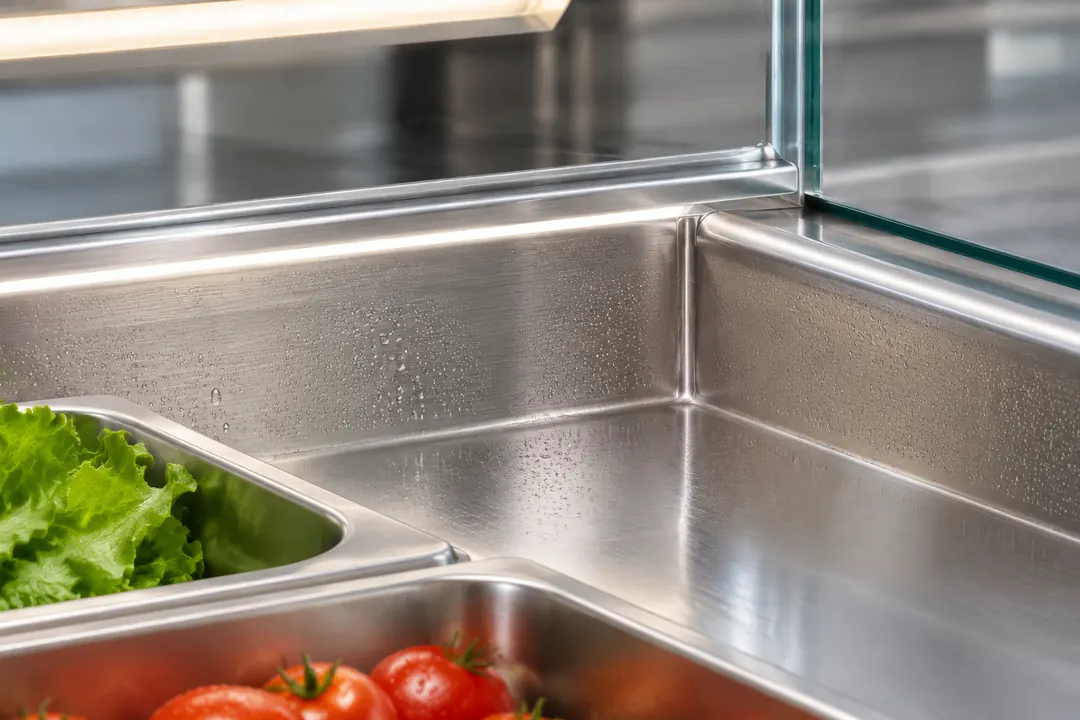
Both are austenitic stainless steels, but their alloy composition differs:
| Element | 304 | 201 |
|---|---|---|
| Chromium | 18–20% | 16–18% |
| Nickel | 8–10.5% | 3.5–5.5% |
| Manganese | Low | Higher (partly replaces nickel) |
| Nitrogen | Low | Added to stabilise structure |
Chromium forms the passive oxide film that gives stainless its corrosion resistance. Nickel stabilises that film, especially in acidic or chloride-rich conditions. In 201, part of the nickel is replaced by manganese and nitrogen to reduce cost — adequate for dry indoor use, but less resistant to:
- Chlorides (salt, brines, seafood, de-icing salts)
- Condensation and standing water
- Chlorinated cleaning agents and sanitisers
- Acidic food residues (citrus, sauces, vinegars)
The practical result: 201 can develop rust at cut edges, weld points and bent corners after 3–5 years in a wet kitchen, while 304 typically lasts 10+ years with routine care. The price saving of 30–50% is real, but it can be erased by early replacement and downtime.
A note on magnet tests: A magnet is not a reliable grade test. Austenitic stainless can become slightly magnetic after cold working, bending or welding. Request a mill certificate or XRF/PMI test report instead.
3. Powder-Coated and Galvanised Steel
Powder-coated cold-rolled steel is a cold-rolled sheet with an electrostatically applied polyester or epoxy-polyester powder, cured under heat. Advantages:
- Wide colour range for brand identity and zone coding.
- Good resistance to everyday wiping and moderate humidity.
- Lowest cost for large retail fit-outs.
Weak points:
- Chips and scratches expose the base steel. In a humid cabinet, condensation finds that spot and rust starts from underneath the coating.
- Edge coverage is critical — ask about coating thickness (typically 60–100 µm) and edge-wrap quality.
- Not suitable for direct food contact or aggressive cleaning chemicals.
Galvanised steel uses a zinc layer for sacrificial protection. It is economical and reasonable for dry back-room use, but cut edges, drilled holes and bent corners lose protection. Avoid it for seafood, high-humidity produce or any surface that is washed down daily.
4. Titanium (PVD) and Electroplated Finishes
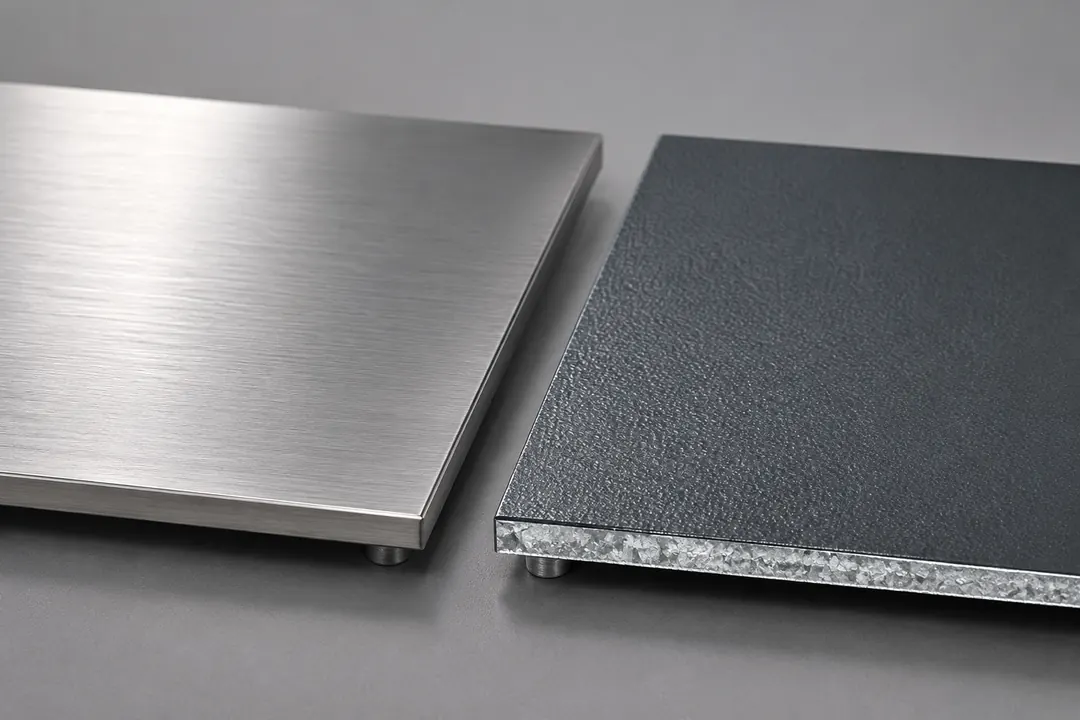
These are decorative surface treatments, usually applied over stainless steel or steel.
PVD titanium (TiN) coating:
- Physical vapour deposition produces a hard, adherent layer in gold, rose gold, champagne, grey or black.
- Good scratch and chemical resistance; the finish is stable under normal cleaning.
- Works best over a 304 substrate. PVD over 201 will still show substrate corrosion if moisture penetrates.
- Specify the coating thickness and ask for a sample panel — finish consistency between batches varies.
Electroplating (chrome, nickel, zinc):
- Lower cost and widely available.
- Plating can peel or pit over time, especially at edges and in humid environments.
- Best for trim, handles and light-duty decorative parts rather than work surfaces.
Where these finishes pay off: hotel bars, lounges, premium beverage displays, boutique retail — anywhere the cabinet is part of the interior design. In a kitchen or wash-down area, choose function (304) over finish.

5. Match Material to Industry
| Industry | Recommended exterior | Recommended interior / food-contact | Reason |
|---|---|---|---|
| Restaurant kitchen | 304 or 201 stainless | 304 stainless | Frequent washing, grease, sanitisers |
| Seafood / wet market | 304 stainless | 304 stainless | Chloride and constant moisture |
| Supermarket display | Powder-coated steel or PVD finish | 304 or 201 stainless / coated steel | Branding and appearance drive exterior; interior sees food contact |
| Convenience store | Powder-coated steel | 201 stainless or coated liner | Dry environment, cost-sensitive |
| Pharmacy / healthcare | 304 stainless | 304 stainless | Cleaning agents, hygiene audit |
| Hotel / bar front-of-house | PVD titanium or electroplated | 304 stainless | Aesthetics matter; interior still needs hygiene |
| Food processing plant | 304 stainless throughout | 304 stainless | Washdown, HACCP, chemical cleaning |
| Cold room / warehouse | Galvanised or powder-coated panels | Galvanised / coated panels | Dry, low-visitor environment |
6. Internal Components: The Hidden Specification
A quote that says "stainless steel cabinet" is not sufficient. Specify each component:
| Component | Recommended for wet/hygienic use | Budget option |
|---|---|---|
| Inner liner | 304 stainless | 201 stainless or powder-coated steel |
| Shelves | 304 stainless with rolled edges | Coated wire shelves |
| Door frame | 304 stainless | 201 stainless or ABS |
| Worktop | 304 stainless, 1.0–1.2 mm | 201 stainless |
| Legs and frame | 304 or galvanised steel | Powder-coated steel |
| Fasteners | 304 stainless | Zinc-plated steel |
Checking these line by line prevents the common dispute where a "stainless" cabinet arrives with galvanised shelves and rusts at the first washdown.
Which material suits which industry is mapped in How to Choose a Commercial Refrigerator by Industry.

7. Food-Contact Compliance
Where a surface touches unpackaged food, material choice becomes a regulatory matter:
- China: GB 4806.9-2023 (Food Safety National Standard — Metal Materials and Products for Food Contact), implemented September 2024.
- EU: framework Regulation (EC) 1935/2004 and national food-contact requirements.
- US: FDA 21 CFR for food-contact substances; NSF/ANSI 51 where specified.
Request material certificates and surface-treatment documentation for any shelf, liner or worktop in direct contact with food. A generic "food grade" claim without a certificate is not sufficient for audit.
8. Cost and Lifecycle Analysis
Material cost should be evaluated over service life, not at purchase:
| Scenario | 201 stainless | 304 stainless |
|---|---|---|
| Upfront cost | Baseline | +30–50% |
| Expected life in dry storage | 6–8 years | 12+ years |
| Expected life in wet / coastal kitchen | 3–5 years | 10+ years |
| Cleaning compatibility | Mild cleaners only | Broad, including chlorinated sanitisers at correct dilution |
| Replacement downtime | Higher | Lower |
For a premium finish, add PVD coating cost over the substrate. The coating does not replace a suitable substrate — it protects it.
9. How to Verify What You Are Actually Buying
- Mill certificate showing grade, heat/batch number and chemical composition.
- XRF or PMI test for project orders — portable XRF gives an instant composition reading.
- Component-level confirmation in the quotation: outer panel, inner liner, shelf, worktop, frame, fasteners.
- Coating specification for powder coat: powder type, colour code, film thickness, adhesion test result.
- PVD specification: substrate grade, coating type, colour reference, sample approval.
- Pre-shipment inspection photos marking each component.
- Written warranty that distinguishes material defects from coating wear.
FAQ
Q: Is 304 or 201 stainless better for a commercial refrigerator? A: 304 is better for wet, salty or hygiene-sensitive environments because of its higher nickel and chromium content. 201 is acceptable for dry indoor areas where budget matters and maintenance is controlled.
Q: Can I tell 304 from 201 with a magnet? A: No. Both can be slightly magnetic after forming or welding. Use a mill certificate or XRF/PMI test to confirm the grade.
Q: What is titanium gold refrigerator finish? A: In commercial refrigeration it normally means stainless steel with a PVD titanium-nitride coating that gives a gold or rose-gold appearance. It is a decorative surface treatment, not solid titanium.
Q: Is powder-coated steel suitable for a kitchen refrigerator? A: It is suitable for the exterior of a dry or moderately humid kitchen, but not for food-contact surfaces or areas washed down with harsh chemicals. Chips in the coating can rust.
Q: How long does a stainless steel commercial refrigerator last? A: A 304 stainless unit typically lasts 10+ years with routine care. A 201 unit in a wet or coastal environment may show corrosion within 3–5 years.
Q: What material is best for a seafood display cabinet? A: 304 stainless throughout. Chlorides from seafood and constant moisture attack lower grades and coatings quickly.
Q: Should the interior and exterior use the same material? A: Not necessarily. Many cabinets use a powder-coated or PVD exterior for appearance with a 304 stainless interior for hygiene. Specify each component separately in the quotation.
Q: What documentation should I request for food-contact surfaces? A: Request a mill certificate or material test report, plus evidence of compliance with the destination market's food-contact rules such as GB 4806.9-2023, EU 1935/2004 or FDA 21 CFR.
References & standards cited
Specifications in this guide are traceable to the documents below. Where a rule depends on your destination market, confirm the current text with the authority or an accredited certification body before it goes into a contract.
- GB 4806.9-2023 — metal materials and products in food contact (China)
- Regulation (EC) 1935/2004 — EU framework regulation on food-contact materials
- FDA 21 CFR — food-substance requirements for food-contact surfaces; NSF/ANSI 51 where specified
- AISI/UNS austenitic stainless compositions 304 (S30400) and 201 (S20100)
About this guide
Written by the SEEBERR application engineering team in Binzhou, Shandong. We manufacture commercial display refrigeration for supermarket and convenience chains in export markets; these guides describe how to specify equipment, not which of our models to buy. Send us your floor plan, product mix and climate conditions at info@seeberr.com and we will return a layout with case counts, door swings and ventilation gaps marked.